
Getting Into China in 2026 Is Sooo Much Easier Than It Sounds

The Night View of Raffles City and Cruise on Yangtze in Chongqing
This is the question I get most before my friends’ first trip here: “do I actually need a visa?” Here's the two-minute version. There are three lanes into China right now, and almost everyone reading this fits cleanly into one of them. Find yours, and the rest of your planning gets a lot simpler.
Lane one: you just show up
If your passport is on this list, you don't apply for anything. Thirty days, tourism or business or visiting family, no embassy visit, no fee.
Europe: Andorra, Austria, Belgium, Bulgaria, Croatia, Cyprus, Denmark, Estonia, Finland, France, Germany, Greece, Hungary, Iceland, Ireland, Italy, Latvia, Liechtenstein, Luxembourg, Malta, Monaco, Montenegro, Netherlands, North Macedonia, Norway, Poland, Portugal, Romania, Russia, Slovakia, Slovenia, Spain, Sweden, Switzerland, United Kingdom
Asia-Pacific: Japan, South Korea, Brunei, Australia, New Zealand, Thailand, Singapore, Malaysia, Kazakhstan, Georgia
Middle East: Bahrain, Kuwait, Oman, Saudi Arabia
Americas: Argentina, Brazil, Canada, Chile, Peru, Uruguay
This list has grown fast. Countries that needed a full application two years ago are on it now, the UK and Canada only joined in February. So even if you checked last year and came away discouraged, check again. Bring a passport with a few months of validity left and a return ticket, and that's genuinely the whole requirement.
Lane two: you're passing through, not just visiting
This is the one most people miss, and it matters most if you're American. The US isn't on the thirty-day list. But it's on this one, the 240-hour transit policy, good for ten days, no visa, as long as China is one stop on a longer route rather than the only destination.
Europe: Albania, Belarus, Bosnia and Herzegovina, Czech Republic, Lithuania, Serbia, Ukraine
Americas: United States, Mexico
Asia-Pacific: Indonesia
Middle East: Qatar, UAE
The rule is simple once you see it. You need an onward ticket to a different country within 240 hours of landing. Tokyo, then China, then Bangkok works. China, then home, does not. That's a round trip, not a transit, and it needs the visa in lane three instead.
Here's the part most guides skip. This isn't just a Beijing and Shanghai thing anymore. The transit zone now covers sixty-five entry points across twenty-four provinces and municipalities, which covers almost all the major destinations and Chongqing is one of them. So a route that runs through here instead of the obvious two cities still qualifies, and you can move freely across the wider region on the same ten days.
Lane three: the L visa, and why it's less annoying than it used to be
If neither lane fits, tourist visa, no free list, straightforward round trip, you'll need what's called an L visa. This is the one that used to scare people off, and it's genuinely gotten easier. Since the start of 2024, standard applications no longer need flight bookings, hotel reservations, or an invitation letter attached. You register through China's online COVA system, take a passport photo, fill out the form, and bring your passport in person to a consulate or visa center. Processing typically runs a few working days, and fingerprint collection is being waived for most short-stay applicants through the end of 2026.
A few things that used to be worth worrying about, and aren't anymore
The old paper arrival card is now a five-minute form you fill out online before you fly (China's Digital Arrival Card, mandatory since November 2025), instead of scrawling it out on the plane. Forget to do it in advance and you can still fill it in on a kiosk or QR station at the airport, but doing it the night before on hotel wifi beats doing it at the gate. And if your transit window is about to close and your plans shift, a visit to the local exit-entry office (出入境管理局) before it runs out sorts things cleanly, rather than after.
None of this needs to eat your planning time.The Free First Timer Kit by Yedu walks through exactly what to check for your passport, what to download before you land, and what to have ready at the border, so the only real decision left before this trip is which hotpot spot to try first.
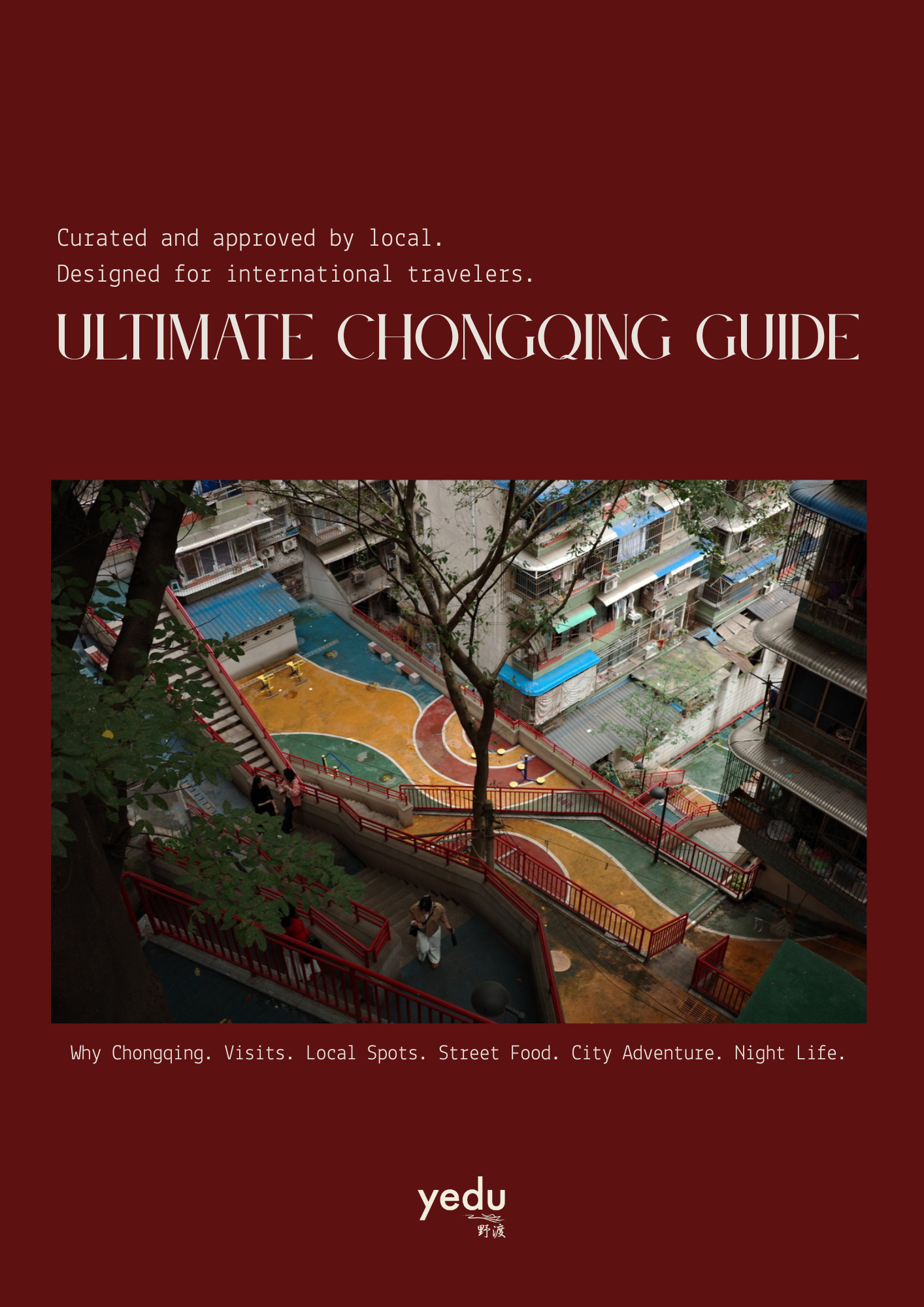

Seven hours, one local, the full shape of the mountain city.
Chongqing is a city best understood on foot. The hills, the staircases, the neighborhoods stacked on top of each other - none of it makes sense from a map. It only clicks when you're in it.
A full day gives you the whole arc: old lanes in the morning, a proper local lunch, and by afternoon you're on a ridge watching the Yangtze bend around the city. We walk through residential steps, hillside temples, ancient trials, and viewpoints only locals know. No rushing, no script, just a discovery day with enough time to actually read a city.
Come with good shoes and curiosity. Leave understanding why Chongqing doesn't look like anywhere else in China.